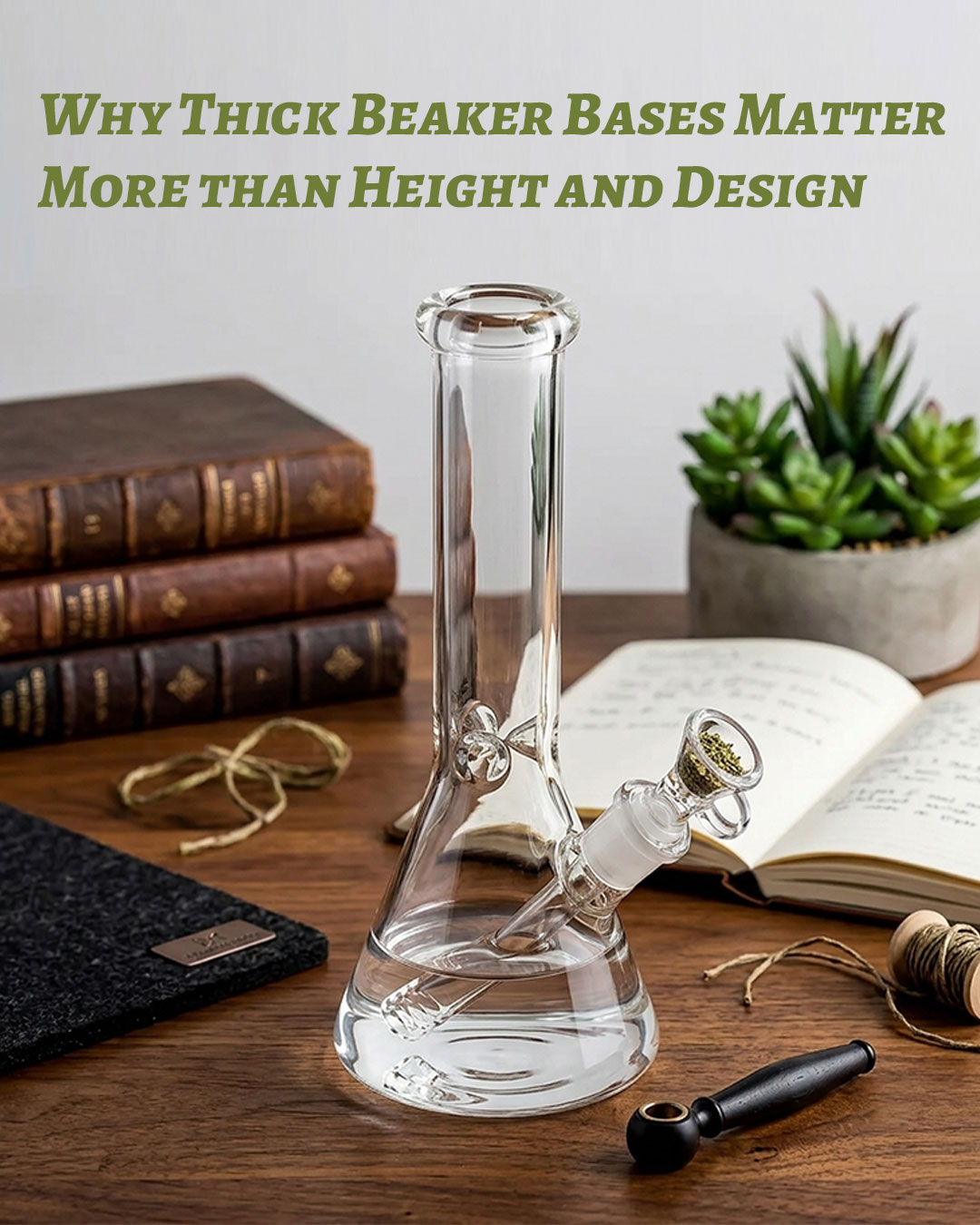
Base thickness genuinely matters and the difference between a 3mm base and a 12mm base is not subtle. A thicker base lowers the bong's center of gravity, absorbs impact energy when the piece gets bumped, and resists the stress fractures that cause failures.
Here’s what you need to know at–a-glance:
brightshining has spent years obsessing over one thing most brands barely think about: where a bong actually breaks. That is part of the reason TAG beakers ended up with massive 12mm to 16mm bases long before thick-bottom beakers became common across the industry.
A lot of that came from trial, failure, redesigns, and eventually CAD modeling that helped map stress points more accurately. The goal was never to make glass that simply looked thick. It was to make beakers that survived real daily use without sacrificing airflow or balance.
To understand why base thickness changes so much about the experience, it helps to look at how the beaker design actually works in practice.
A heavy beaker base is one of those design choices that looks like a drawback until you understand what it actually does. The weight is the result of stacking heavy layers of borosilicate glass where the piece meets the surface, and that mass does real mechanical work.
A low center of gravity is the single most effective way to keep a beaker upright. When most of the glass mass sits at the base, the piece resists tipping the same way a weighted chess piece does . You can nudge it, and it returns to center rather than toppling.
Straight tube bongs sit high and light, which is this is the style most likely to survive get knocked off a table. A beaker with a thick base distributes weight downward, so accidental contact with a sleeve or an elbow becomes a non-event instead of a disaster.
Glass fails because stress concentrates at thin points. A 5mm base has almost no capacity to absorb the energy from a drop or a knock; a 12mm base spreads that energy across a much larger cross-section, which is why the crack never forms in the first place.
Think of it like the difference between snapping a pencil and trying to snap a wooden dowel of the same length. The material is similar; the cross-section is everything. In our beaker lineup, that same principle is why a piece that slides off a wet counter survives where a thinner base would not.